Recreating Elizabethan England: Sacha Wiernik on capturing The Lady Grace Mysteries
Currently airing on BBC, The Lady Grace Mysteries follows a teenage detective, who works as a spy for Queen Elizabeth I in the English court during the Elizabethan era.Alongside her companions, Lady Grace Cavendish must uncover a series of mysteries while navigating threats, plots and royal secrets. Sacha Wiernik SBC served as the series DOP.

While set in England, the series is produced by French company Cottonwood Media, who produce both French and British programmes. “Although my own background is in feature films, commercials and music videos, I was slowly moving towards TV projects,” begins Wiernik.
A producer from Cottonwood Media got in touch with Wiernik as they were looking for a Belgian DP to shoot The Lady Grace Mysteries. “They were familiar with my work already. They discussed the show and informed me that it’s a historical, period drama set in the 16th century at the court of Elizabeth I, which required recreating life in the castle, the court and life around that time. The show is based on books that were written as different episodes.”
The original idea was to create something historical, but also very modern. Wiernik found the combination to be an interesting challenge. “The goal was to blend those together to create an interpretation of that period and bring a modern look to it with colours and some (chosen) anachronism.”
When Wiernik arrived on the project there was already a chosen artistic direction. “They had demands on the direction they wanted to go and had references such as Sofia Copolla’s Marie Antoinette and more recent TV series, like Bridgerton. Bridgerton was maybe closer to what they wanted to achieve. Although our show is historical, it’s not supposed to be believable history. It’s meant to be historical entertainment and so it doesn’t have to be perfectly accurate. In this case the only reality is Elizabeth I, every other character is fictional.”

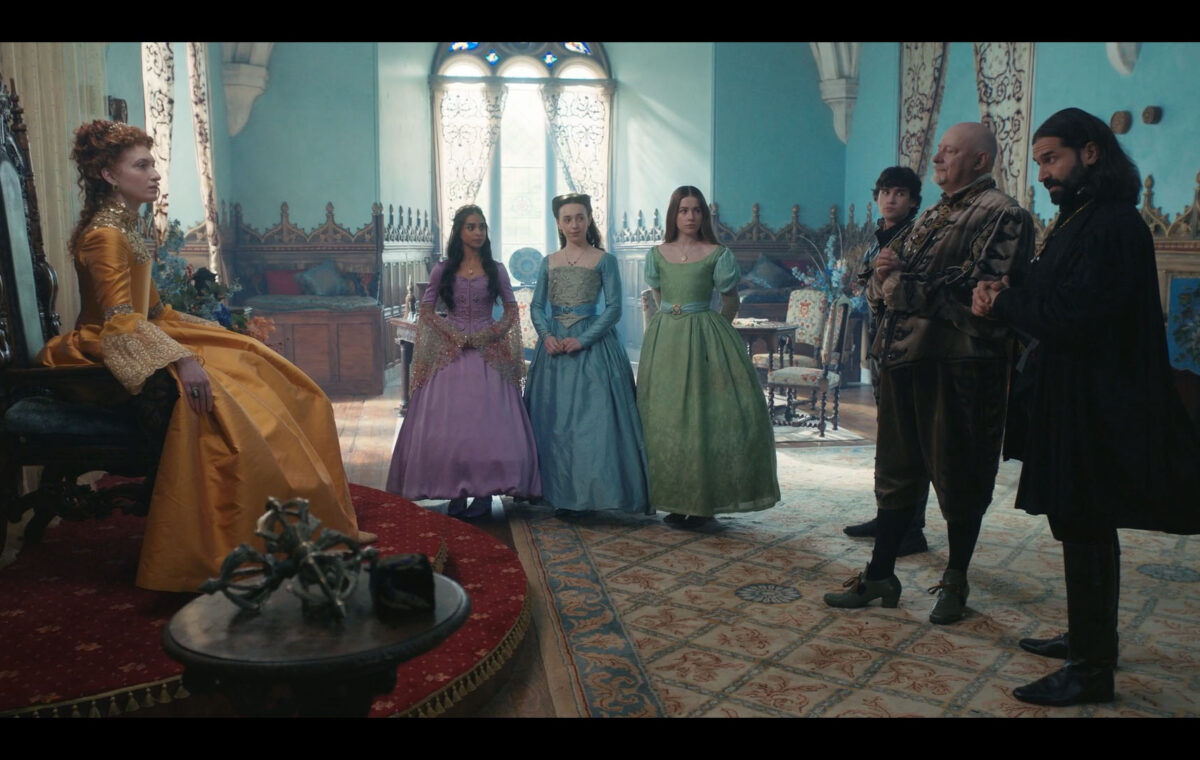
Wiernik admits it was much different process from arriving on a project with a director and creating everything from scratch. “I could treat the lighting and camerawork the way I wanted, but ultimately, I was trying to translate their vision and ideas they already had in mind,” he says. “They’d been working on the cast and costume for a few months previously. I was rather surprised to find the costumes were so colourful and the colour palette was unusually vibrant and saturated for that period.”
Wiernik explains that each of the main characters all came with their own colour code, an element he found quite interesting. “Each character has dresses or clothes that essentially remain the same throughout the whole show, with the occasional different outfit,” he adds. “So, they are very personalised by their specific colour. The protagonist, for example arrived in a very strong, saturated green dress. That was extremely challenging because she’s often accompanied by her friends, one of which wears a purple dress and the other blue. Those looks were well defined already.”
As the series is a period drama, Wiernik relied heavily on recreating natural lighting for the exterior and interior scenes. “The characters are often shrouded in nature, so it was challenging to dress my main character in bright green while surrounding her with greenery. One of my tasks was figuring out how to create enough separation between her and the environment through lighting.”

Wiernik ran camera and lenses tests as a very specific LUT was needed to determine the right saturation and hue for each character, since they are often together in the same scenes. “All those colours could easily blend into the locations and the particular lighting style I wanted.”
There were also many night scenes to contend with, which Wiernik and his crew lit with fake fire or candlelight. They avoiding using real fire or candles, for safety reasons. “Itwas mostly LEDs,” he details. “It was interesting to have this colour palette to see how it reacted with the camera sensor. Our goal was to achieve a specific look while keeping every character’s specifications in terms of colour, allowing deep shadows as well”
Skin tones were another consideration as it was important for every different ethnicity to be well represented and to be accurate in the colours. “We also wanted to make sure it was visually interesting for audiences,” says Wiernik.

Each day presented new challenges and there was limited time to shoot the project, as well as the added difficulties of working with a limited budget. “There were lots of actors and extras and sets,” says Wiernik. “We mixed locations between Belgium and the UK. The castle is meant to be somewhere in the UK of course, but we were lucky we had beautiful locations in Belgium that could stand in as the UK. We are very rich with our historical patrimony, so it was very interesting. We had to keep locations together for logistical reasons. Safety was also paramount, especially working with a younger cast, so any real fire we used was extremely controlled.”
For Wiernik, trying to visualise historical locations involved numerous logistical challenges. “We were working in castles and historical buildings, where the windows were often 15 metres of higher. Navigating light within those spaces was a challenge. Key light may be coming from windows themselves, or even fireplaces. We had very little time to prepare in that sense. I had worked out a beautiful plan to rig all our lighting, and I was lucky we could built very big setups involving big constructions and always plenty cherry pickers on the Brussels Grand Place city Hall, The Mechelen City Hall and mostly our main Castle in North East UK and many more locations.”

For night scenes, Wiernik and his crew had to react quickly to the given scenarios they were presented with. One solution involved characters carrying lanterns which could act as a main lighting source. Wiernik worked closely alongside gaffer Tom Van den Abbeeleto combat a number of different hurdles.
Additionally, Nanlux provided a range of lighting sources, including the Nanlux Evoke 5000B and all the range below. “We were one of the first productions to use many of these,” says Wiernik. “We used between two and six 5K each day. It was extremely convenient working with these lights. It became obvious that it was the right tool to do this show. It fit perfectly with the project to make something very stylised and colourful. Everything fit together at the end.”
The Evoke’s particularly helped with faking day for night, we often mixed them with ARRI Skypanels X21 froe RGB use or direct Sun/Moon effects “The weather can also change very fast, so getting the lights to enter at the right angles was difficult when working in castle huge rooms located always very high from the ground asking a huge number of cranes and condors to reach the high windows. Making consistent light during the day was also a challenge. We also had to fake night and we had lots of set ups to block the light for those scenes. We had to be very inventive and creative to be ready. From a technical perspective we were quite innovative.”
Another sequence where the lights came in handy was for Grand-Place location in Brussels. “It was amazing working there. We had eight of the lights in a row in the front of the Grand-Place main wedding room, which is huge. It was a big setup, but we were able to effectively light it. If I put Dinos there we would have melted these historical buildings.”

Wiernik selected ARRI ALEXA Mini LF to capture the show, accompanied with ARRI Ensō Prime lenses. “I wanted to use vintage lenses, but I like the wide format with LF,” he says. “I wanted to use a convenient set of lenses. I hadn’t worked with them before and they had quite precise demands on production, but they were open to my approach.”
The lenses came with a vintage kit that included small diopters which attach magnetically to the back of the lens. “This made it easy to alter the look of the image, from a clean, normal look to one with heavy distortion. I wanted distortion, but I also wanted control over it, since we were aiming for a very specific visual style. I like having a sharp centre with softer edges around the frame, especially in a wide-format image.We also had lots of handheld or Steadicam sequences, I also used a dolly, some cranes and a gimbal. It was a light and efficient set-up.”

When approaching the project, Wiernik treated it as any other, despite the target audience being for teenager viewers. “I never really adapted for the audience with that demographic in mind. I think we achieved the right look for the show.”
Looking back on the project, Wiernik is quick to acknowledge the role the production played in making the visual ambition a reality. “On this type of show, with this kind of budget, you shoot an enormous amount of material every day with 2 or 3 cameras,” he says. “You have to be fast and extremely efficient. In that context, my lighting demands were quite heavy – perhaps unusual for this format.”

Despite the pace, the production backed every request. “They followed me on choices that weren’t obvious, and I think it surprised them in the best way. We ended up going much further visually than most productions of this type typically do. When they saw the results, they were genuinely delighted.” For Wiernik, that trust made all the difference. “I’m truly grateful for the confidence they placed in me. It’s what allowed us to push the work to a level neither of us had necessarily anticipated from the start.”
By Oliver Webb