Masterclass: Manu Dacosse
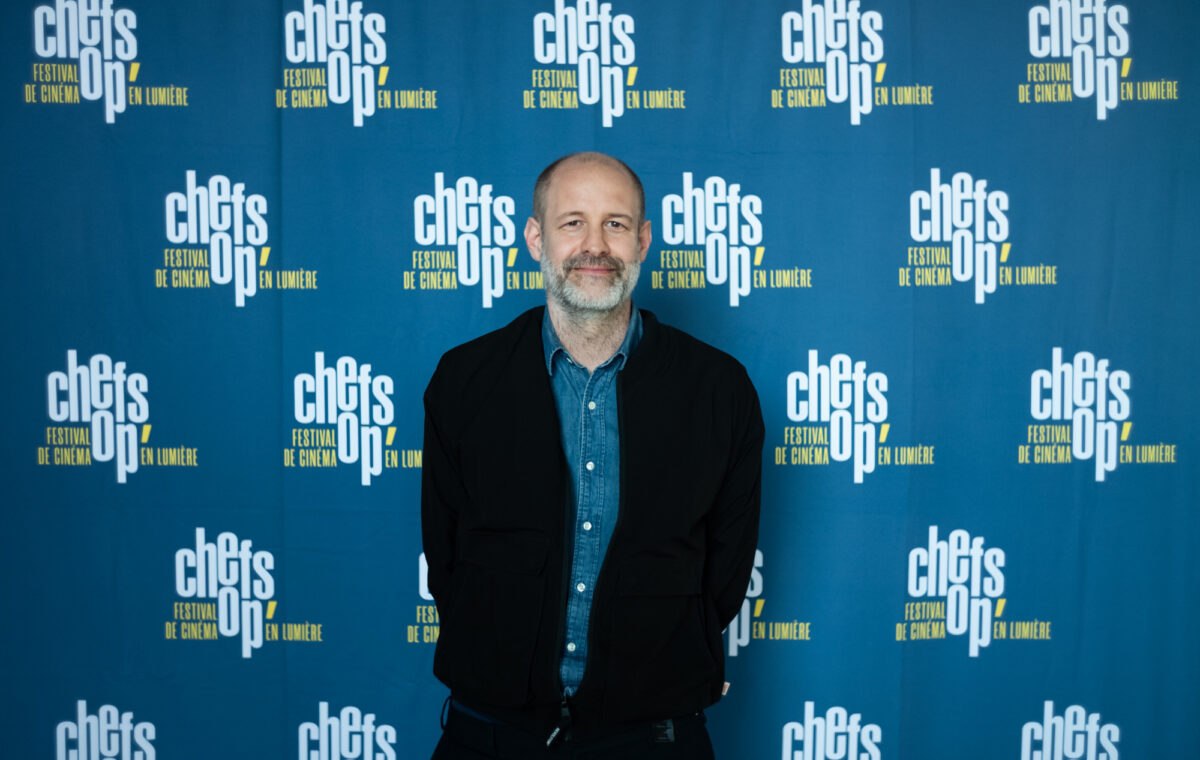
One of the standout events of this year’s Chef Op’ festival was the masterclass by Director of Photography Manu Dacosse SBC in the main cinema hall of the Espace des Arts in Chalon-sur-Saône. For 1.5 hours, he discussed his career, the films he has lensed, and his long-standing collaborations with the duo Hélène Cattet / Bruno Forzani, Fabrice Du Welz, and François Ozon.

Manu Dacosse, born in 1977 in Brussels, began filming in his adolescence with a group of friends, with whom he enjoyed making parodies of 1980s/90s television series. He often found himself, somewhat by chance, holding the camera, and when it came time to choose a career path after turning 18, his friends encouraged him to follow this route by enrolling at the IAD. After his three years of study, he began working as an electrician, grip, and then camera assistant on shoots in Belgium and Lebanon, for commercials and feature films. He also worked as a camera assistant at a company called Flying Camera, specializing in aerial cinematography before the advent of drones, which allowed him to observe shoots for major Anglo-Saxon productions. These years also enabled him to observe extensively and begin learning cinematography techniques.
In parallel, he started working on short films by Hélène Cattet and Bruno Forzani, heavily influenced by the worlds of 1970s Italian films, known as Giallo, which blend crime, horror, and erotic cinema. He made five of these before lensing “AMER,” the duo’s first feature film in 2009, in the same formal vein, inspired by the films of Mario Bava (“Black Sabbath,” 1963) and Dario Argento (“Deep Red,” 1975). This directing duo offered him immense visual creative freedom and pushed him to constantly explore primary and saturated colors further, a departure from what he had learned more academically at school, in a more naturalistic style where the main idea was to enhance existing light and always rely on natural light sources to illuminate a scene.


This very low-budget film had a certain international impact and opened the doors to his future career. It was listed among Quentin Tarantino’s favorite films in 2010 and was selected for Camerimage in the “Cinematographers’ Debut Competition” section. After this film, three more feature films followed: “The Strange Color of Your Body’s Tears” in 2013, “Exotic Murder” in 2017, and finally “Dead Man’s Mirror” in 2025, for which he won the Best Cinematography award at the Magritte Awards (which became the René Awards in 2026) each time.
Manu describes the very personal and atypical working method of this directing couple, who meticulously and precisely prepare each shot of a film. A complete storyboard with drawings (albeit approximate), framing, movement, and action indications, as well as precise details about props, sets, and effects, is created before shooting to allow for optimal team preparation. This enables the crew to know exactly what will be done on set, ensuring maximum efficiency, with a shooting schedule often comprising between 30 and 40 shots per day! Nothing is left to chance, and by the time the rest of the crew begins preparations, everything is already decided, sets are chosen, and the storyboard is complete. Hélène and Bruno use the frame very precisely to tell their stories and leave little room for maneuver on set in this regard. It is primarily in lighting that Manu can unleash his creativity and artistic desires. Manu explains that he has never had the opportunity to work with other directors who operate in the same way, which is what makes their work so unique and interesting. The duo greatly encouraged him to light differently, less naturalistically, and to use colors without inhibition. The framing in these films, which is the primary narrative tool for this directing duo, taught him to tell stories visually, to evoke sensations in the audience with the camera. The use of close-ups and a fondness for the 2.35 aspect ratio are assets he would later bring to other films he had the pleasure of lensing. For him, the cinematographer must be able to adapt to the working methods of the film’s director, and there are as many methods as there are directors. It is interesting to note that all four feature films were shot on S16mm, in a 2.35 aspect ratio, and this particular aesthetic left a significant mark on him.
This learning experience in using color in Cattet/Forzani’s films led him to use color extensively in his other films, pushing him to always go further in this direction. He explains that making an image colorful does not necessarily mean lighting in color or creating color from scratch, but rather relying on the colored elements already present in the image, whether it be the hue of the sets, existing or practical lights, costumes, or props.
In “Vincent Must Die” by Stephan Castang, released in 2023, he explains how, to create colored lighting atmospheres, he most often uses existing colors and practical lights, which can very often be the primary or even sole source of light for a scene. He then supports or reinforces this source with other additional lights and colors. For example, in a gas station scene, using the red of the illuminated signs, he then introduced blue, a complementary color to red, to create color contrast. He then moved the table where the actors were discussing to harmoniously arrange the gas station in the background and give depth to the scene. If the table had been closer or further away, the result would not have been the same, and the shot less composed. For him, this is also the work of cinematography: proposing a staging to bring out the best in natural or existing elements and to take maximum advantage of what is available.


Similarly, in the film “The Silencing,” directed by Robin Pront and released in 2020, which he shot in Canada, he shows how, based on scouting photos, he relied on the most visual elements of the set (such as the perspective of the ceiling neon lights) to create depth and light the actors in color contrast to generate dynamism in the image. In an example of shot/reverse shot, he explains that sometimes it is necessary to accommodate certain visual requests from the actors. An actress preferring to be filmed in one profile rather than another might lead to shooting by breaking the 180-degree axis, and ultimately, it is not that problematic.


In Lucile Hadzihalilovic’s film “Evolution,” released in 2015, he was presented with another challenge: not to use “cinema” lights inside the set (no projectors specifically designed for cinema), and to shoot almost exclusively in static shots. Lights could be installed outside, but all interior lights had to come from practical lamps, meaning those integrated into the set. To successfully create an interesting aesthetic atmosphere, not necessarily naturalistic, with contrast, while still allowing the actors to be seen, extensive collaboration with the production designer was undertaken regarding the hues, textures of the walls, and the lamps within the set, as well as their placement.


In the hospital, a large set in the film, tests were conducted on the walls to try out colors and types of paint to use. Manu explains that he greatly favors glossy paints, which help him create contrast in the image, and which are used more often in Anglo-Saxon culture than in French culture, where matte finishes are more common.


He also explains, using photos, that with the film’s reduced budget (around 700,000 euros), they had to make do with what they had on hand. The lamp overlooking the operating table was created by the art department from a paella pan in which Par lamps were installed in a star pattern, recalling a visual element omnipresent in the film, and this lamp is the sole light source for the sequence. For this film, shot in Lanzarote, which took place largely outdoors, the volcanic rock offered a magnificent natural contrast with the white houses of the village. Shooting in natural light does not mean being at the mercy of the light; for this film, a fairly precise exterior shooting plan was made, along with precise scouting of the sun’s orientation and shooting times, to maximize the use of sunlight, obviously favoring backlight and the times at the beginning and end of the day. Shooting lightly, with few lights, also allows for faster movement, and it often happened that he would shoot interior sequences in the middle of the day when the sun was at its zenith and the light less beautiful, and then go out to shoot at the end or beginning of the day when the rays were more oblique. However, this is only possible by keeping the precise shooting plan firmly in mind and having meticulously prepared the shots beforehand.


Manu then discusses his long-standing collaboration with Fabrice Du Welz, with whom he has made four films: “Alleluia” in 2014, “Adoration” in 2019, “Inexorable” in 2021, and “The Maldoror Files” in 2024. Similar to Lucile Hadzihalilovic, Fabrice Du Welz prefers not to use lights on set and relies heavily on natural and practical lighting. Extensive art direction work is done beforehand between him, the director, and the production designer Manu de Meulemeester to choose the set lamps, as well as their colors, which give direction and emotion to the sequences. Fabrice Du Welz has also greatly influenced Manu’s work regarding the integration of natural elements such as fire, water, and wind into the image. It was with him that he began to use a lot of smoke on sets, an invisible smoke that resembles fog, which helps materialize light rays and create depth in the image without over-lighting a scene. He shows an excerpt from “Alleluia” where the two protagonists dance around a fire, with changes in shooting cadence to create slow-motion and fast-motion effects and accentuate the characters’ madness. The only light source used was the fire.


He also shows a shot from the film where the characters enter a cinema. The shot was initially planned for daytime, but the set made the image too naturalistic, so it was decided to shoot at night, light the building’s facade in red using red neon lights, and create a water trail on the ground. This is a prime example of the importance of art direction in Fabrice Du Welz’s films.


In “The Maldoror Files,” Manu discusses the importance of justifying light in Du Welz’s films and the placement of diegetic sources to lend credibility to the realism while creating the contrasting and anxious atmosphere characteristic of thrillers. A major cinematic influence for him was discovering David Fincher’s film “Seven,” shot by Darius Khondji AFC ASC, where light sources are always very well integrated into the set and action.


“Maldoror” was the first film shot digitally by the Dacosse/Du Welz duo; all other films had been shot on Super 16mm. Tests on film and digital were shot beforehand, showing the quality of film capture concerning skin tones and outdoor nature colors, particularly greens. A LUT was developed to emulate the film look on digital images.


The choice of lenses is also crucial for a distinctive look. He always prefers to choose older lenses to give the image character from the outset of shooting. In “Vincent Must Die” by Stephan Castang, released in 2023, the budget was limited, so he opted for fewer focal lengths within a series of anamorphic lenses rather than a more complete set with less character. They used the 35mm, 50mm, and 75mm from a Techno-Zeiss anamorphic series made from Zeiss High Speed lenses coupled with a front anamorphic adapter, as well as a 14mm spherical lens for very wide shots and an Angenieux 25-250mm HR spherical zoom. He does not hesitate to mix anamorphic and spherical lenses in the same film depending on the shooting situation, always favoring anamorphic lenses, which create a specific and characteristic bokeh and background distortions. Even though the anamorphic aspect ratio is often 2.35, he does not hesitate to crop the image when the film’s ratio is tighter to preserve the character of these lenses. For “Vincent Must Die,” scouting was decisive, and the hours spent on the road led to discussions about exterior and interior sets and the formal desires linked to these locations. It is often the photos taken during scouting, adjusted to the film’s aspect ratio, that serve as references later for finding the film’s framing and the most interesting axes. Manu shows some examples of the link between scouting and shooting.


On the occasion of his visit to the festival, Manu presented “Dead Man’s Mirror” as well as the film “The Stranger,” released this year, directed by François Ozon and adapted from Albert Camus’ novel, for which he was nominated for the César Award for Best Cinematography in 2026. “The Stranger” is his fifth film in collaboration with François Ozon. A collaboration that has led him to experiment with other aspects of his work. François Ozon is the cinematographer for all his films, and Manu explains how pleasant it can be to handle the cinematography from behind the monitor, allowing him to concentrate much more on lighting and the actors’ performances. This distance allows for more ideas regarding framing, storyboarding, and narration. François Ozon likes to make films with very different visual identities, ranging, for example, from a naturalistic color detective film like “By the Grace of God” to a black and white film inspired by 1950s film noir like “The Stranger.” He likes to shoot using zooms, which allow him, within the same shot, to go from wide shots to close-ups when the actors’ performances are intense, which can sometimes be a real challenge for lighting, as close-ups often require essential lighting adjustments. For the needs of certain films, with the desire to enhance the actors, Manu sometimes lights more softly and frontally, meaning with less light contrast. This constraint has thus taught him to find ways to contrast the image without having to contrast the light. He gives as an example a scene from the film “Double Lover,” released in 2017, where Jérémie Renier and Marine Vacth face each other in a very white setting with very soft light, in front of a mirror. In this scenario, to maintain character and contrast in the image, it was decided, in collaboration with costume designer Pascaline Chavanne, to dress the two protagonists in black. The art direction work involves coordinating all departments according to the situation to achieve a visually interesting result adapted to the chosen setting.


The placement of actors is also a crucial choice for lighting. In this scene, the actress Marine Vacht was deliberately placed facing the light, while the backlight on Jérémie Renier gives him a more unsettling aura. If the placements had been reversed, it would not have conveyed the same narrative about the characters in the film. To create an image, it is important to develop personal tastes in many areas. Styling, architecture, and painting are all sources of inspiration that help find visual solutions. With the aim of concretely communicating a visual universe in preparation for a film, Manu has, over the years, created a reference image bank that mixes all styles and influences. The work of preparation and educating one’s eye happens in everyday life by being attentive to everything around us. He is, of course, particularly interested in photography and painting and cites Raymond Depardon, Paolo Pellegrini, and Caravaggio as very significant personal visual references. In his collaboration with François Ozon, Manu often works upstream of the shoot to find shots, to propose them, and to feed the storyboard ideas. On the film “Double Lover,” the film’s visual leitmotif was duality, reflection, the double, and extensive work was done on mirror effects. For a particular sequence where mirrors were arranged in a circle, fragmenting the space in the manner of Orson Welles’ “The Lady from Shanghai,” Manu obtained miniature mirrors from the set designer and used small Playmobil figures to invent shots and propose them to the director.


To return more specifically to the film “The Stranger,” presented at the Chef Op’ festival this year, Manu explains that he began by reading Albert Camus’ novel to immerse himself in the atmosphere. The question of color or black and white then arose, and it was during the initial scouting that black and white was chosen. Firstly, to distance the film from Visconti’s 1967 version with Marcello Mastroianni, but also to imprint a period imagery, as the film is set in the 1940s. Pawel Pawlikowski’s film “Ida” was a strong reference for François Ozon, who wanted to play with off-center framing in an aspect ratio that was more square than usual, as the film is framed in 1.66. Manu then proposed images from films such as Patrice Leconte’s “The Girl on the Bridge,” shot by Jean-Marie Dreujou AFC, or Steven Spielberg’s “Schindler’s List,” with harsher, more contrasted lighting.


Black and white also allowed for a direct and interesting link with the film’s opening archives, which were very important to François Ozon. Manu had prepared with his usual DIT a high-contrast black and white shooting LUT that allowed for a monochrome image with character to be visualized on the monitors and in the camera’s viewfinder. At the end of the day, data manager Victoire Bonin applied slight corrections to the shots for more polished continuity. The original book is set in Algiers, but the filming took place in Tangier, a city with a more Spanish style. The buildings were therefore often replaced in VFX with buildings in a more Haussmannian style. At the beginning of the film, a sequence of exterior shots in which Meursault moves allows for a rapid contextualization of the universe and environment. These shots were prepared in advance with precision during scouting, paying attention once again to the sun’s orientation and shooting times. François Ozon usually prepares a sequence chart that he shares with the team, including a photo of a planned shot per sequence to give an idea of the main axis.


The film’s aesthetic form was constructed in the first days of shooting, and the idea of working primarily with static, highly composed, and simple shots perfectly contributed to the book’s heavy atmosphere, a form of character immobility, and the existential aspect of the narrative. The economy of dialogue lends the image a certain iconic power. The lighting is all the more important as the narrative is built around the idea of the character being blinded by the sun, leading him to commit a murder. It was around this idea that the desire to work with sharp and harsh lighting, both indoors and outdoors, day and night, germinated.


Meursault’s interior was shot in a first-floor apartment in the city center. An M90 projector was installed on the roof of the building opposite to light the living room and kitchen. The north-facing facade never allowed direct sunlight into the apartment.
In many night sequences, bare filament bulbs can be seen, which also create a form of glare and harsh light on the actors, even at night. In the scene where Meursault keeps vigil over his mother in the mortuary room at the beginning of the film, a ceiling bulb in the foreground illuminates and blinds the character. This bulb is the sole light source in this setting.

To achieve this, Manu chose to shoot with an Alexa 35 for the first time and was amazed by the immense dynamic range this camera offers, especially in the highlights. “Unlike an Alexa Mini or Mini LF, the Alexa 35 must be overexposed and offers greater dynamic range in the highlights than in the low lights. It never seems to saturate in the highlights, so it was the perfect camera for this film.”


The masterclass lasted an hour and a half and was moderated by Philippe Rouyer, a critic for the journal Positif. You can find the full masterclass video on the website: https://www.festivalchefsop.fr/