
Reinventing the 90s: Florian Berutti on the punk world of Nino dans la nuit (Nino in Paradise)
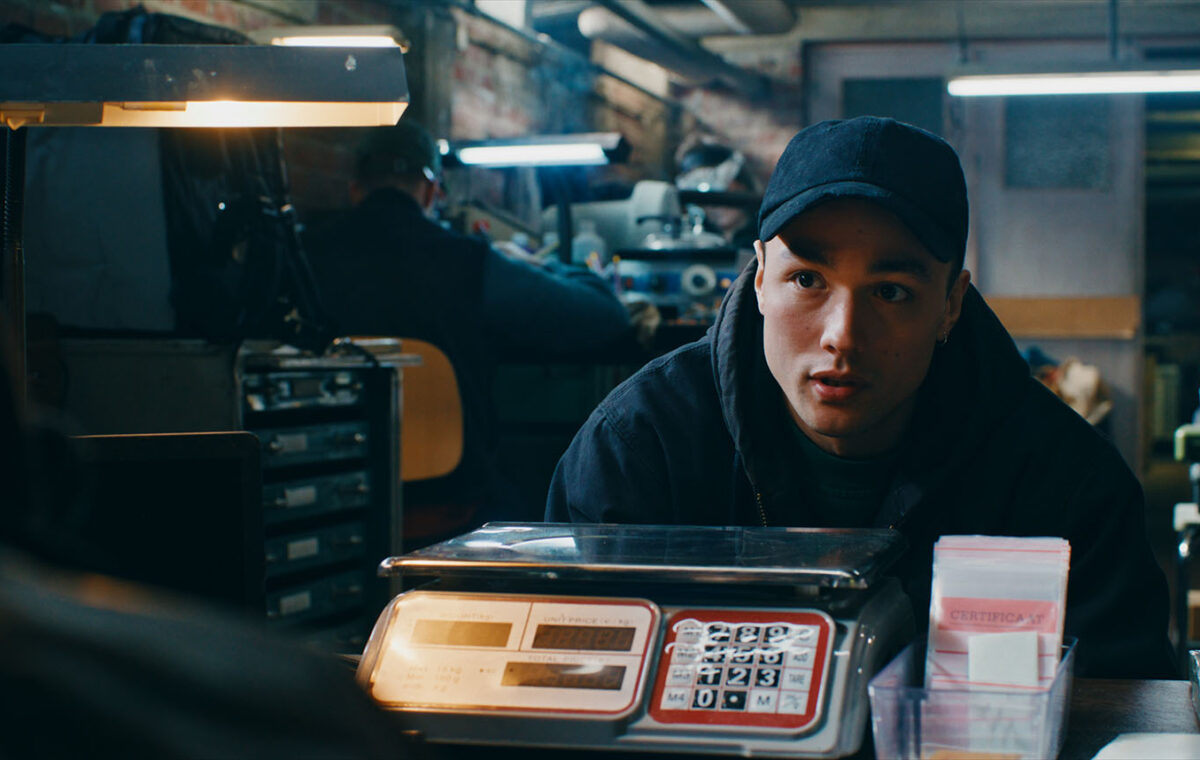
After a failed attempt to join the French Foreign Legion and escape the police, Nino Paradis reunites with his girlfriend Lale and his two best friends, Malik and Charlie.
With no direction and little hope for the future, they spend their time hustling, partying, and searching for direction.
Berutti has known director Laurent Micheli for almost twenty years. “We have very good friends in common, but we weren’t close by any means,” he begins. “When Laurent started looking for a cinematographer for his film, I imagine our friends wanted us to meet.”
Berutti devoured the script in two hours, as well as the book the film is based on bySimon and Capucine the next day. “I immediately knew it was a film for me,” he admits. “My adolescence in the 90s was similar to Nino’s—lots of parties, drugs, noisy music… The world spoke directly to my soul. And most importantly, I knew this was a film where the cinematography would be crucial because the atmosphere would be a narrative element in its own right. I was finally going to be able to show a more complex range of what I’m capable of. I can do more than just long, contemplative realistic shots.”

Micheli and Berutti knew the film would have a very distinct aesthetic, but the danger was falling into pure aestheticism. “I feel that today, many film stills look like perfume ads or music videos – which I deeply dislike.”
There’s a dark romanticism in the novel that needed to be preserved – “a language that’s both violent and deeply sensory,” says Berutti. “We wanted the film to feel dark, high-contrast, gritty, and raw, while still working carefully with colour. Nino moves through many different worlds, which makes the film very baroque yet at the same time, I had to maintain unity amid all this fragmentation. That was the real challenge.”
Since he knew he wanted the film to come from his gut, Berutti admits that he drew a lot from his own youth. “And it felt only natural to turn to 90s cinema for inspiration. The most obvious influence for both Laurent and I was Wong Kar-wai. I still remember discovering Happy Together at 20 and the visual slap in the face it gave me. Christopher Doyle remains one of my greatest role models – a true punk and an artist at the same time. His intuitive approach to colour contrasts, his raw mannerism, his use of frame rates… There’s a freedom in that kind of cinema that I feel has been lost in contemporary filmmaking.”

James Gray’s Little Odessa was another major reference, with its grimy realism and those scorching nights that fully embraced the city’s sodium glow. They also discussedGaspar Noé’s films, particularly Benoît Debie’s unique use of colour.
“In photography, we looked at a lot of Wolfgang Tillmans, Nan Goldin, Lise Sarfati and more 90s references, of course,” he says.
The big risk with all these 90s influences according to Berutti, was falling into a vintage, overly referential style, with fake film grain, when what they really wanted was something very contemporary. “We aimed to reinvent what we loved about the films of our adolescence and offer a modern reinterpretation of them. So, we chose to create a very defined image—sharp, with no texture at all.”
The year before this project, Berutti had shot a film in Kenya where he used the RONIN 4D for chase sequences through tiny alleys. “It was while using the RONIN 4D that I realised I loved Full Frame – a format I had carefully avoided until then,” he says. “For NINO, with its 90s punk spirit, it was obvious I’d be using very short focal lengths. That’s how Full Frame became the natural choice, and we went with the RED RAPTOR for its massive sensor.”
Because of the free party sequences, Berutti needed zero rolling shutter to push the strobes to their full potential, which is why the KOMODO X became their B-camera. “We tested at least 15 sets of lenses before ultimately going with my own. I’ve been collecting all kinds of Soviet LOMO lenses for 20 years.”

Lomos are soft yet have a very expressionist blur, and they retain a raw, punk, uncontrollable quality. “They were the perfect choice for this film,” explains Berutti. “And since we were shooting Full Frame, I was able to pull together some real rarities from my collection: LOMO Super Speeds, LOMOs for 70mm, ultra-rare LOMOs for still photography, and ultra-wide focal lengths.”
The most challenging sequence for Berutti to capture was the final scene at Villa Empain. “We needed a location that could convincingly pass for Paris’s high-fashion and luxury world, and Villa Empain was perfect for that,” he says. “But it meant lighting a huge space with almost no practical sources in frame to help me. Since Villa Empain is a listed building and given our minuscule budget, no heavy rigging was possible. In the end, we lit almost entirely with indirect tungsten… though it still came out a bit underexposed.”
There was only two days for the shoot, so the entire ending was shot with two cameras – “a setup I really hate for lighting direction,” adds Berutti. “But I’m ultimately very happy with how we were able to refine the look in grading.”

The free party sequence was divided into four parts: the arrival, the dancing, the backstage moments, the second wave of dancing, and finally the afterparty. “During pre-production, I created a colour palette to map out the chromatic evolution throughout the sequence. The idea was to clearly distinguish these four sections while building a colourcrescendo toward the afterparty / hell.”
For lighting, the ceiling was so low that they rented actual small LED party lights controllable via DMX, plus three strobes. “For camera movement, we instinctively decided to shoot handheld with short focal lengths to experience the party from within, to be among them and stick to the bodies,” says Berutti. “Then, during the afterparty scene, I switched to a 14mm lens and danced with NINO to feel the intensity of his drug high. It was all very instinctive and exhilarating.”

Berutti acknowledges that there wasn’t a big budget, which ultimately meant that the lighting package was pretty minimal. “I work mostly with LEDs because my obsession is colour, and they’re much more practical. But generally, I almost never light during the day. At night, I rely heavily on the practicals provided by the set decoration. The additional cinema lights are just there to create colour complexity and contrast.”
Before becoming a cinematographer, Berutti was a colourist. “Ever since, I’ve worked exclusively with LUTs derived from KODAK 2383,” he says. “It’s always been the foundation of my work. But I never use them on set. I prefer to expose as accurately as possible in REC709, and then in the evening when I grade the dailies, I reinvent my day’s work by applying a Print Film LUT. On Nino, it was the first time I used a LUT from FilmBox, and it definitely brought more nuance than what I’d achieved before with technical LUTs.”

For the grading, Berutti worked alongside friend Lou Brenta at Cobalt Film. “He’s the one who trained me as a colourist, so it goes without saying that we know each other well and trust each other completely. With Lou, I always come to the grading session with a very advanced pre-grade and bold proposals. It’s almost like a challenge between us. I suggest ideas, hoping he’ll bounce back with even better interpretations of the sequences than I could have imagined. It’s incredibly stimulating, and stress-free, since the film is already there by the time we start.”
The shoot lasted 31 days, with quite a few small additional shoots outside the official schedule. “Just me, Laurent, and actor Oscar,” says Berutti. “We refused to let the film’s limited budget prevent us from achieving the result we envisioned. So, there are plenty of stolen shots: on trains, in the streets, at markets… It was an incredibly intense shoot.”

For Berutti, the film had such a familial, good-natured atmosphere. “I took so much pleasure in shooting this movie, surrounded by people who were happy to be there and giving their all because they all believed in the project,” he says. “Despite our minuscule budget, Julian – the production designer who’s also Laurent’s partner – did such wonderful work that it was always a joy to film amidst his sets. Honestly, it’s one of the films I’ve enjoyed making the most in my life.”
Key camera crew
Myriam Amouri – 1st AC
Sylvain Chaux – camera operator
Thaïs Play David – best girl electric
Paul Desecot – additional electrician
Emilien Faroudja – Gaffer
Emma Manrique – additional grip
Guenael Pinson – second assistant camera
Brice Roustang – best boy electric
Romain Tardy – key grip
Mathilde Warnier – second assistant camera Paris
By Oliver Webb
