Framing faith: Virginie Saint-Martin on lensing Mother
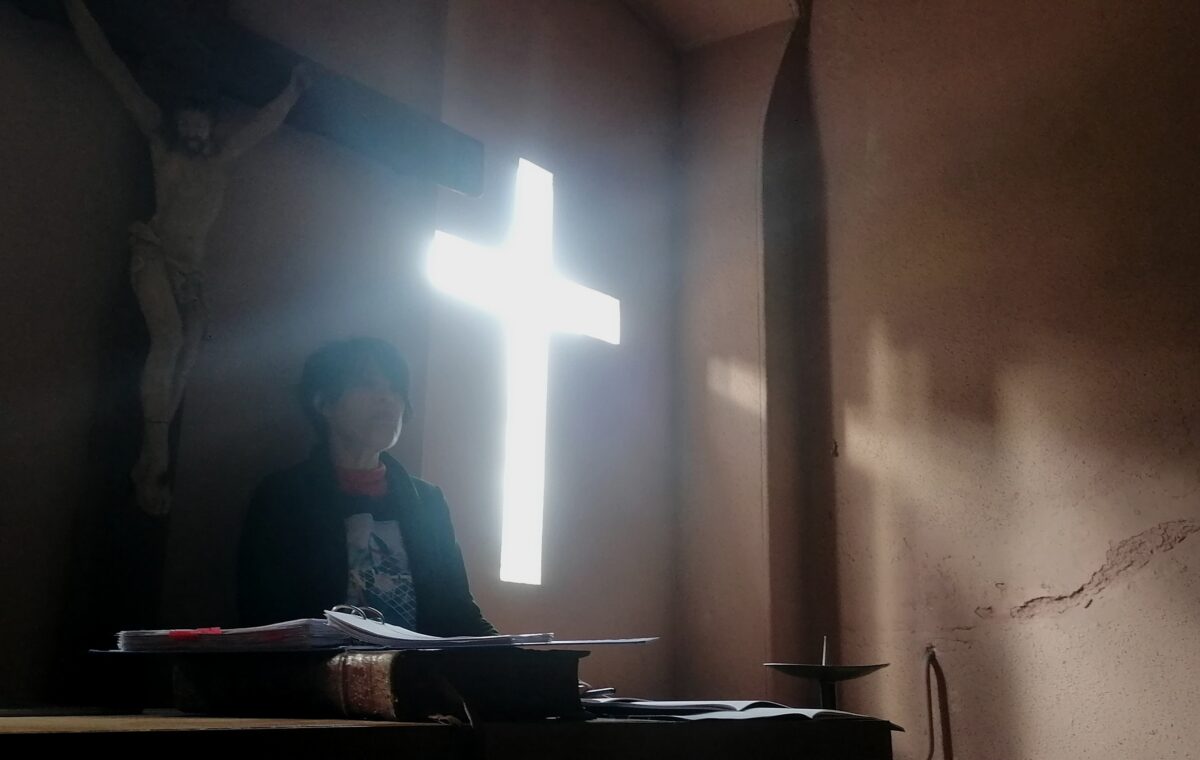
Directed by Teona Strugar Mitevska, Mother is a fictional account of seven days in Mother Teresa’s life leading to her decision to leave her convent in Kolkata and establish her own religious order. The film sees DOP Virginie Saint-Martin SBC reunite with Mitevska, having previously collaborated on I Am from Titov Veles (2007), God Exists, Her Name Is Petrunya (2019) and The Happiest Man in the World (2022).

“Teona and I are used to working together,” begins Saint-Martin. “This project was very low budget. We cast Noomi Rapace as the lead, and after salaries the budget became even tighter. Teona and I always do lots of work and prep together when we begin a project and before we shoot.”
For Saint-Martin, it’s about finding the visual language. “It’s also about figuring out how we will shoot it,” she says. “Teona changes her approach with every film and this was no different. She’s always questioning cinema and what cinema means.”
Saint-Martin’s and Mitevska’s initial conversations about the look of Mother revolved around framing Mother Teresa (portrayed by Noomi Rapace). “At the beginning, Teona wanted a square format,” adds Saint-Martin. “The French distributor didn’t allow for that as they argued they wouldn’t be able to sell it. So, we tried 1.66:1 aspect ratio before ultimately settling on 1.85:1.”
Saint-Martin admits that this was challenging due to allowing for space in the frame above Mother Teresa. “When you are not in the square frame, then it’s very strange,” she says. “We tried to find a way around it, but Teona desired that look. I know her process very well and understand how she works.”
Saint-Martin explains that together with Mitevska they develop a visual language and build from there together. “We are always building and there’s always trust. Teona and I both bring something and it’s always back and forth between us. We know each other very well.”

Despite this, Saint-Martin admits that working with a well-known actress as the lead was somewhat stressful for Mitevska. “It’s very different from our previous work together where we worked with people from Macedonia. That was a lot easier for her,” she admits. “Noomi was completely involved, but she only took two takes whenever we started shooting. She really gave everything, but it’s hard to play with that and I’m not sure Teona was so relaxed working in that way.”
Saint-Martin acknowledges that you have to be very involved as a cinematographer and was impressed with Rapace’s work ethic. “I’m always on Teona’s side and I understand her pressure,” she says. “I was very impressed by the way that Noomi acts. It’s very interesting. There was a lot of handheld camera work. We really danced together and she trusted me a lot.”
Saint-Martin admits that she is usually someone who is very quiet on the set. “I have the mindset of working quietly and staying focused,” she says. “Noomi and I both respect each other and our way of working and I said to Teona to use her trust that she has in me. I didn’t feel any pressure at all. It’s also quite easy to have the light on Noomi, she’s very beautiful. It was very interesting to light and her frame her. I was really in love with this actress.”

All of the interior scenes were shot in Belgium, while the exteriors were captured in Kolkata in India. “We found the old monastery in Belgium and that was completely empty. The new owner said we could do what we want. Teona’s brother, Vuk Mitevskiwas the set decorator. It was very interesting because we played with the light, colour and brightness and we always made these tests together.”
Saint-Martin’s gaffer on the film was Vincent Piette. The two have known each other and been friends since they were twelve. “We pre-lit all the set,” explains Saint-Martin. “I told production the light budget would be expensive, but it meant we could shoot everywhere. That was very interesting because we set up like a studio.”

Saint-Martin relied on a range of LED sources, including Lightstar Luxed, AputureFresnels and Nanlux. “Nanlux wasn’t enough by itself as it wasn’t interesting for me,” she notes. “I started off as an electrician and I really like Fresnels, which we mixed with 6K and the Luxed. We put LED panels everywhere that we could. It’s not a lot though. It’s interesting for me to put the light outside because it’s a handheld movie and I had to follow Noomi.”
Although the budget allowed for the lighting fixtures that Saint-Martin desired, she explains that it was still challenging to light. “I could be very free with my camera movement and during one scene, Teona hid in the corner of the room where we shot with a monitor. She was actually in the frame a few times. You always felt that it’s a master shot during the edit. It’s always work in progress, but in the sense that means something.”
Rapace was always able to move freely and embrace the space. “Teona did direct her, of course but Noomi did what she wanted,” laughs Saint-Martin. “She was always informed by her character and did whatever she thought Mother Teresa would do. As it was handheld I could easily follow her and that’s why I chose to shoot the film with the Sony Burano.”

Saint-Martin opted for the Sony Burano due to its compactness and being more lightweight than the Venice and the Alexa. “My focus puller wasn’t really happy with that, but it’s an easy camera really. It’s perfect for this kind of film. That was accompanied with 15mm Leitz SUMMICRON-C, Fujinon Cabrio 19-90mm, and Lensbabylenses. I ended up using more of my budget on lights than camera.”
Saint-Martin explains that the film isn’t intended to be a biopic and follows Mother Teresa over the course of one week. “She was born in Macedonia and Teona is also from Macedonia. Mother Teresa was in a traditional covenant and then she decided to make her way to help fight poverty. In France, they called the movie Teresa and so people thought it was a biopic, but it isn’t really that at all. It’s a misleading title actually. It’s about what she’s waiting for and there are thriller elements and ultimately, it’s about faith.”
The two had also previously collaborated on a documentary about Mother Teresa and during that project they visit everywhere that Mother Teresa had built. “We had that as an initial reference, but with Teona the references are always about paintings,” says Saint-Martin. “We saw lots of religious painting from the 15th century. You don’t really see direct references in the movie, but it’s always about texture. Teona worked in graphics before, so everything has to be checked on the set.”

The overall shoot lasted 30 days, with 20 days in Belgium and 10 in Kolkata. “It’s really a collaboration between make-up, costume and set design and we made lots of tests and did lots of research. As a DOP, it’s very interesting and any movie like this will be a pleasure for me to work on. I need to fight to be able to make these kinds of tests, even with the director.”
“I’m very proud of this movie because we worked hard between Belgium and Kolkata. It was really rough,” concludes Saint-Martin. “I really enjoyed the Belgian part and meeting Noomi. It was very emotional. Your work will always be better with that level of acting. Noomi is very high level and very involved and focused. I don’t like a set where everybody’s talking.”
By Oliver Webb