Bookish : Anton Mertens on the film noir aesthetic
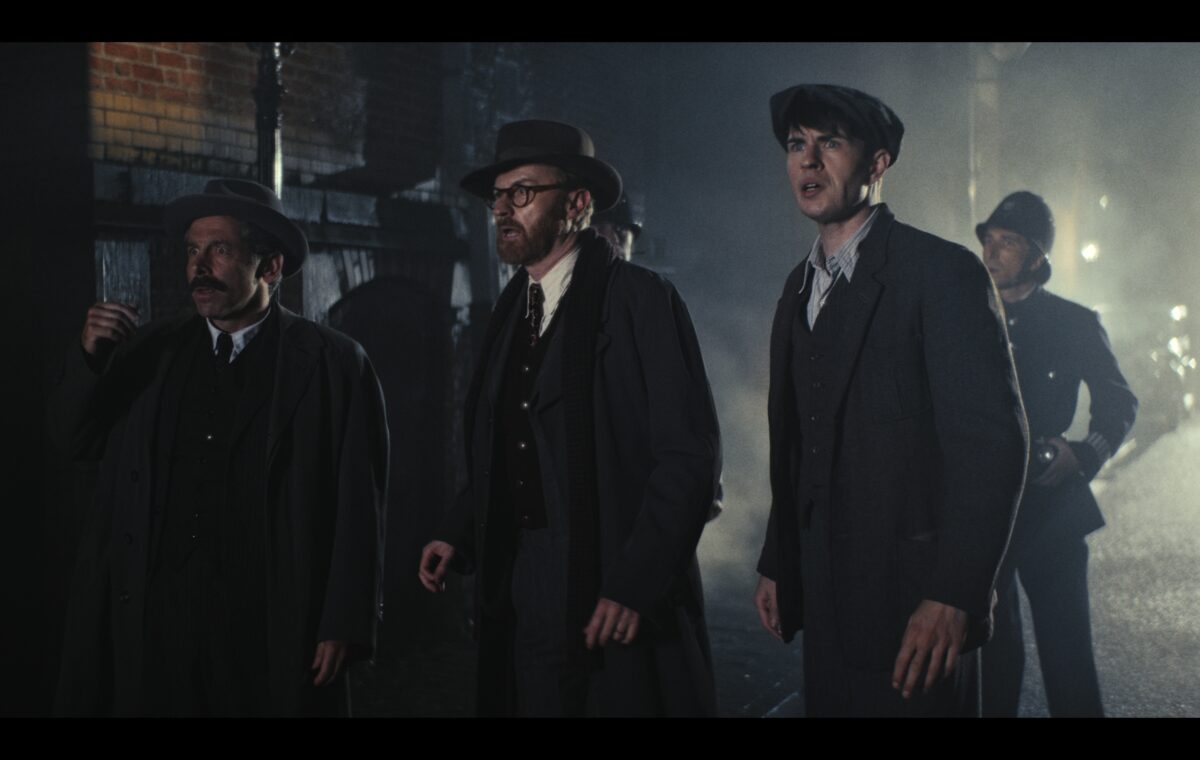
Created by Mark Gatiss and directed by Carolina Giametta, Bookish follows Gabriel Book (played by Gatiss), proprietor of an antiquarian bookshop in postwar London. Book relies on his vast collection to unravel baffling cases and nurtures a group of lovable yet troubled individuals, providing informal protection and guidance. Anton Mertens SBC served as the show’s DOP.
The majority of Bookish was filmed in Belgium, with one week of shooting in London due to finances. “It’s very expensive to shoot in London,” begins Mertens. “We film there to add a bit of a London flavour to the show. Last year we actually shot a scene on the opposite side of the river to the parliament buildings and some how people thought that was a VFX shot. ”
For Mertens, it was important to capture the spirit of postwar London and he points to the fact there are only so many places where you can completely recreate that time period. “People do tell me that our show is a bit of a heightened version of London and not entirely realistic, but they might not be aware of what it looked like during that time,” he says.

Mertens looked at photographs and stills from the late 1940s as a visual reference, as well as films such Hope and Glory (1987), The Maltese Falcon (1941) and The Third Man (1949). “We mostly looked at references for the design of the street and the world around it. The Third Man influenced the film noir element of the show. In its essence it’s a cozy drama, but we didn’t want it to just be that. We wanted it to feel different and a little bit more dangerous, rather than just having a flat look to it.”
Production undertook many searches to find the main street location depicted in the show. Scouting stretched as far as France and The Netherlands to find suitable locations. Ultimately, they settled on a street in Namur, in south Belgium. “We had to find residents that were fine with us putting fake facades in front of their houses because the bottom bits are often set built in front of another house,” explains Mertens.
Most of what you see was visually altered by the art department led by Stijn Verhoeven. “Up until the first floor they’ve put a fake door and wall in front of it to get the style. There were a few houses on the street that already had the old style we needed, which were just painted another colour. A few of the other houses needed entire new fronts put there. You can see them if you watch the episodes that take place in a film studio because we reused them as a dressing in the background.”

Recreating a hotel for that time period proved a challenge for production. The hotel is a mix of different locations, with the individual hotel rooms being studio built. “One part of it is an old school that is partially a museum,” says Mertens. “The bar was a set build in an upper-class club. We also used an abandoned factory for the final scene with Daniel Mays, so it was a very varied mix to create everything. It’s hard to find locations and we didn’t have that many studio builds in the end. The bookshop itself, however, was a studio build and a few other shops as well, but everything else was shot on location. It was a challenge to find all those places that fit the 40s look. We shot in Antwerp, Brussels and Ghent.”
Mertens relied on Sony Venice to capture the show, accompanied by Atlas anamorphic lenses. “We only used 2:1 crop, so you lose a bit left and right of the frame. The scenes are very wordy in terms of dialogue and Mark’s writing is very specific language and wording. The show needs coverage because you need to be able to see the performers perform the dialogue and give the audiences time to figure out what’s happening or what is being referred to. There are lots of references in the dialogue to things that happenedduring that era, as well as of course book references.”
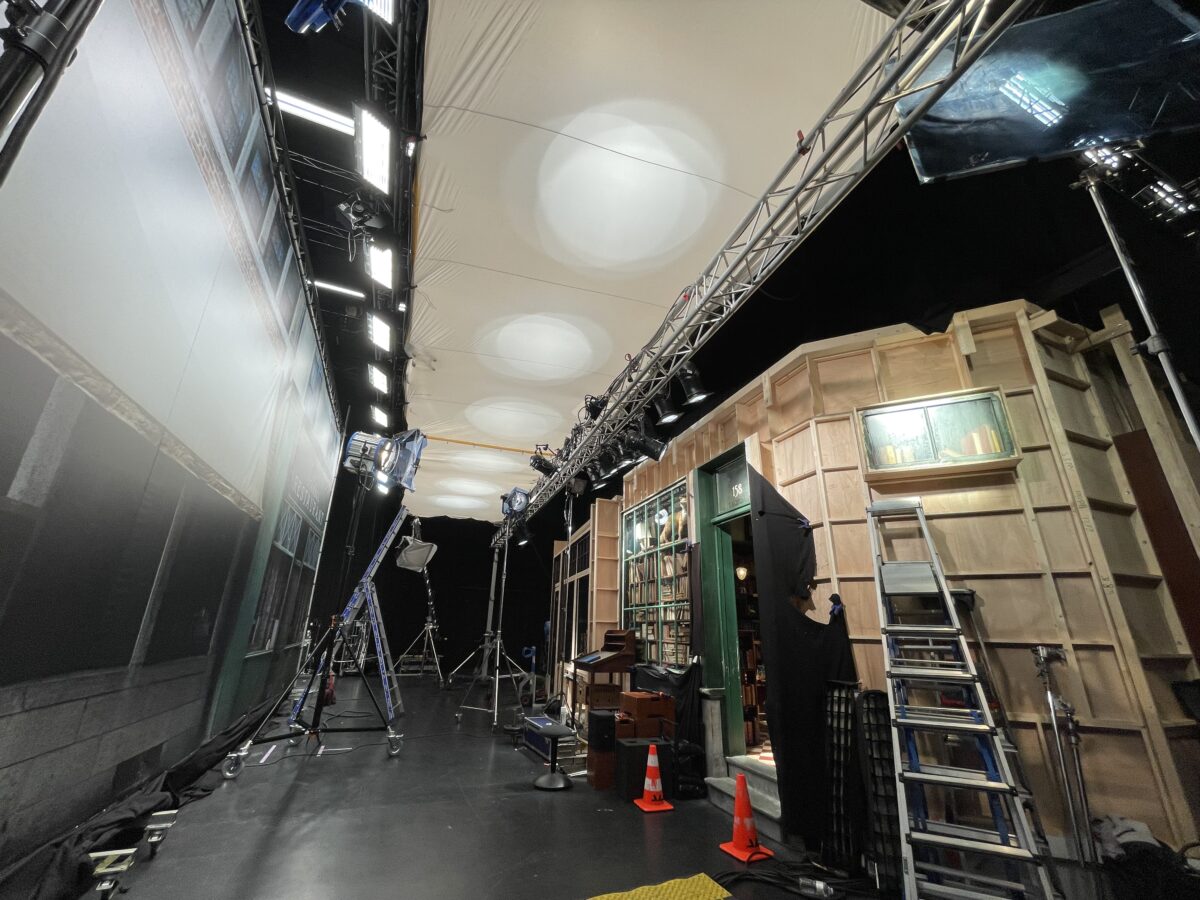
Mertens wanted slight movement throughout and didn’t want it to be too static. After a test day, he came up with the idea of attaching the camera to small jib arm with a remote head, so he could control the camera on wheels from a distance. “The jib operator Julien Chassaignon could keep the camera floating throughout the scene and create coverage,” he says. “It proved handy for the cast being able to play the full scene so they could keep up the rhythm of the dialogue. Sometimes we had scenes that were between nine or fifteen pages, which is quite a lot. We’d track round with the camera and would sometimes go in tighter, or wider, in the same take where normally you would do it separately. That approach proved handy for this show.”
The test day before the shoot also ensured that they could find the right look they wanted. “We brought in people from the art department, costume as well as a stand in and shot different combinations of colours so we could create a colour palette for the show,” says Mertens. “On the basis of that, we created a LUT for the show with colorist Olivier Ogneux. I wanted to have the film noir in contrast with light, but with colour in it. For colour, I took inspiration from Hitchcock’s colour films, his 50s period where all the colours aren’t really perfect.”

Due to London being very polluted by coal emissions and factories during the postwar period, there was license to play with the foggy aesthetic. Mertens opted to light the show with harder sources than usual, due to the film noir influence. “Sometimes you have to rely on lighting to camouflage with smoke and contrast of light,” he notes. “That look also helped to hide some of the locations or sets that weren’t quite 40s style because of the contrast in the shape of lighting.”
Mertens almost never used any diffusion frames or diffusion filters, instead relying on any sources that created more shadows. “We also wanted to create shafts of light coming into the shop, or into locations, aided by having some atmosphere in the room and then sometimes having almost over exposed dots of light on the set. It’s a more partyistic way of lighting.”
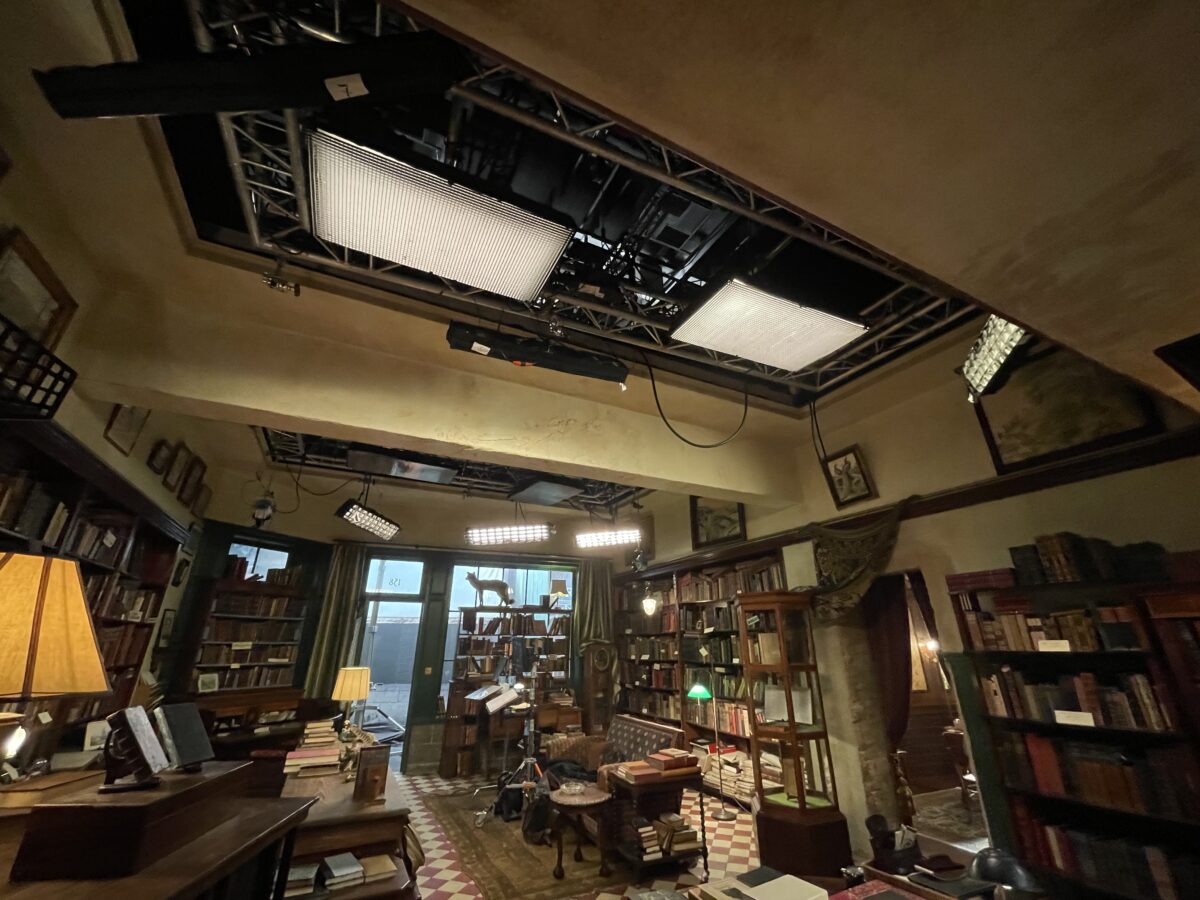
Lighting in the sense, enabled the actors to move into the light during scenes. “There are scenes when you feel there are strange shadows and that’s because they move from one hard light into another. We’re not so used to seeing that anymore, it’s all evened out nowadays.”

For the night scene at the abandoned factory, Mertens used mover rock and roll lights used in concerts. “You can pan and zoom with them from a distance,” he says. “That helped to recreate the beam of the search light across the building and inside the building the light travels across the walls and sometimes puts them in the light, sometimes in the shadow. It takes some practice, and it is bit of a lost art of how to light something in a hard light fashion. It’s harder for the boom operators as well because if they make a shadow, it’s really obvious. I hope to make use of those techniques on a more contemporary project.”
The overall shoot lasted 66 days, with 11 days per episode. “There was never really a brief from production or something in particular that they wanted in terms of look,” says Mertens. “They just let us create it and run with it. I like being able set up the world from scratch, that’s the most fun part for me, the initial creation of it because after that it’s just execution and maintaining the same look over numerous episodes.”

Another creative element of filming were the flashback sequences, which Mertens admits could be more exaggerated than the normal scenes. “We often shot them at the Dutch angle. That was fun to play with. The show didn’t need to be realistic, so you have license to do things with it from a visual point of view.”
Mertens particularly enjoyed creating the world of Bookish, as well as working with Mark Gatiss. “He is so well known, so lots of actors just want to be in the show as he’s written it and is also starring,” he concludes. “I really enjoyed the creation of the world. It’ssomething that’s no longer there, which you only know and recognise from references and films. You can create your own version of that in a way.”
By Oliver Webb