De Big Fuck Up lensed by Piet Deyaert
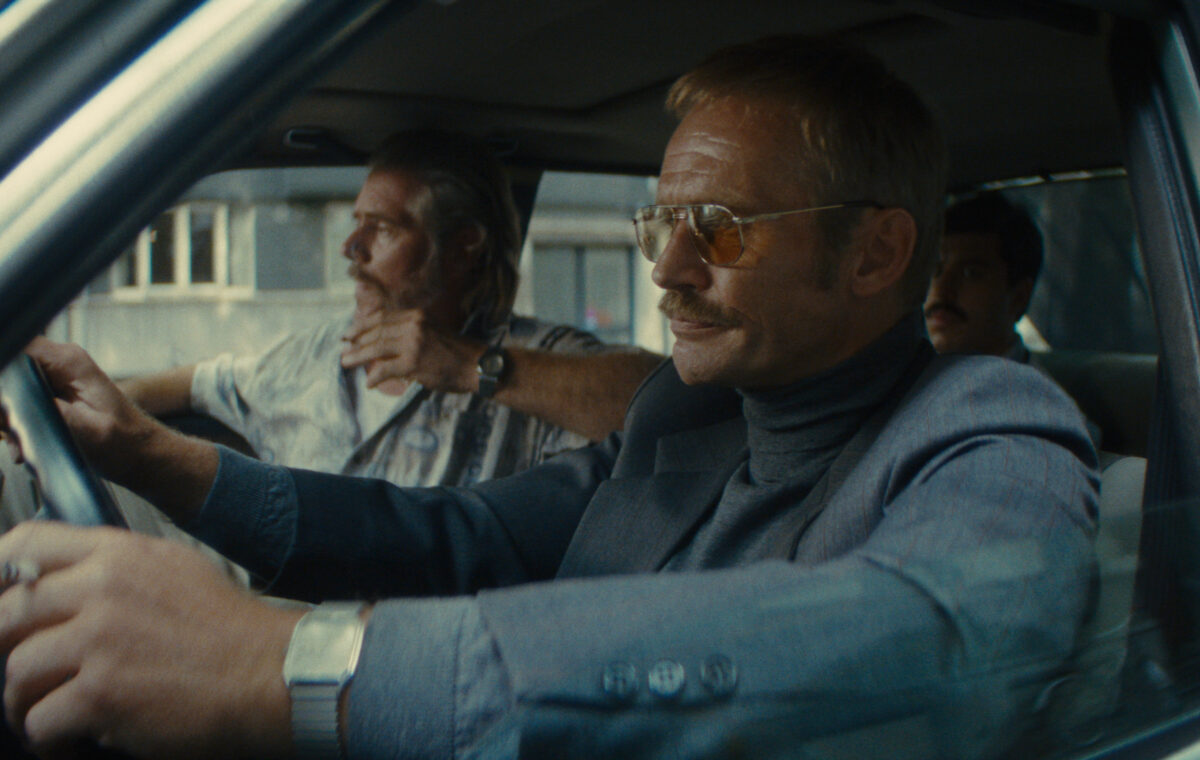
De Big Fuck Up follows Jan Laureys in early 1980s Belgium. After ending up in a prison cell, he reluctantly becomes a gendarme after being given an ultimatum by this father. He soon joins a team of Gendarmes led by an American CIA agent who are tasked with catching drug dealers, but who instead turn to crime themselves. Directed by Wim Geudens, the series was captured by DOP Piet Deyaert SBC.
Deyaert had been working mostly in commercials and other than a few short movies, hadn’t had much fiction experience before being offered to work on the show. “I had been dreaming of shooting fiction,” he begins. “I’d never really had the opportunity, but then all the stars aligned together and there was a good director and a good script. The project all happened because of the director.”
Deyaert had previously worked with director Wim Geudens on a number of projects, having shot a successful music video(Ziet Em Duun by Van Echelpoel) together some years ago. “That’s how we met,” he says. “It was a bit absurd because it was a video clip of a guy who has this act, like an alter ego. It turned out to be a hit, especially in Flanders. We never expected it, but lots of people saw it. That’s ultimately how our friendship and professional relationship started and afterwards we made lots of commercials together.”

Geudens approached Deyaert to join him on De Big Fuck Up. “He told me it was a show involving, Drugs, guns, money and all set in the eighties. So, I said ok, you’ve got me,” laughs Deyaert.
The two watched a number of movies during pre-production. Deyaert also revisited Steven Spielberg’s Munich. “I’m a big Janusz Kamiński fan and he’s always been an inspiration,” he admits. “We also watched Craig Gillespie’s I, Tonya. In that movie we’re following the rise and fall of Margot Robbie’s character in a very down to earth and realistic way. No big Hollywood tricks. Then you have scenes in the bar with the red light, it feels very natural and not like a Hollywood set being lit.”
When it came to the look of De Big Fuck Up, it was important to let it flow organically. “Wim has a movie in his head and an idea of what he wants it to look like,” explains Deyaert. “He pinpoints ideas and often just sends me screenshots of what he likes. Then I start to talk with production and the art director and it all starts to blend together.”
Recreating the 1980s aesthetic was integral to the story, which Deyaert credits to the art director (Toon Mariën), as well as Wim. “All credits go to them because if you enter a set and it’s already that good, then I can only fuck up,” he says.
The most important element the two discussed during the early stages was having a fluid camera movement. “Wim wanted the whole show to be shot on a Steadicam, but it was not possible for us to do that budget-wise,” he says. “He wants to keep the energy high because he’s working with actors. We didn’t want a big lighting setup interior, this wasn’t a show about lighting and technical setups. It should be simple and fast.”

Deyaert admits that Steadicam wasn’t feasible for 80 days of shooting. “I wouldn’t have liked that either to be honest,” he adds. “That would also have meant that I couldn’t operate for that time. For me, operating the camera helps me in getting to know the images, actors and the location. If everything is happening 10 metres in front of me, it doesn’t work. I like to be in the action with them.”
Access Motion developed a small system so that Deyaert could use the gimbal on a Steadicam arm. “The whole series was shot on a French gimbal called Stab One which I operated,” notes Deyaert. “It was handcrafted for us, together with the people from MiraGrip. So, I was there with a Steadicam vest, Steadicam arm and a gimbal on there. I’m not a Steadicam operator at all, but this way meant I could be with the actors and could go with the flow. This also defined the look of the show and the feel. It meant I had to put fluorescent or Astera lights everywhere because you don’t know where the actors will always be. It gave a lot of freedom and room for improvisation.”

Shooting in this style was an exhausting, but overall rewarding process for Deyaert. “I had to see the physiotherapist two times per week,” he recalls. “I loved it, but it was super hard. For me, it was physically the hardest thing I’ve ever done. We did think about giving the gimbal to a grip and I could remotely do the wheels and we tried it initially, but I hated it because I had to communicate everything. I wanted to be able to focus on the story and not lose myself in any communication.”
Deyaert relied on the ARRI Alexa 35 to capture the series. “For me, it’s a perfect camera because I can push the exposure index,” he says. “We shot on 3200 ISO. I love to have the dynamic range of Alexa 35. I also love to use Hollywood Blackmagic filters. We made a comparison between those in front of the camera or in post-production and I couldn’t see the difference. So, all the filters were done in post-production.”

Deyaert opted to shoot the series in anamorphic, which he admits was a challenge. “Most of the time with anamorphics you have to put diopters in front of your lens if you are getting close to an actor, but this limited our freedom. Since I was using the gimbal 90% of the time, there wasn’t time to do that,” he explains.
This resulted in Deyaert searching for lenses with close focus capabilities that would also fit the budget. Tim from MiraCam rental company came up with a range of Chinese lenses DZO Pavo Anamorphics. “For these, they put the anamorphic element in the middle of the lens,” says Deyaert. “This was the first time I’d heard about a lens made like this. We had one of the first in Europe. The advantage was they were super small, perfect for a gimbal and I could have a close focus similar to shooting spherical or something and so I could be really close to the actors. I had the whole set. I think there were around 10 lenses, including a Macro. It was the perfect set to do the series with.”
Deyaert and Geudens purposefully avoided shooting big exteriors and explains that there aren’t actually any establishing shots within the show. “We wanted to be near the character with the gimbal and always circling around him and we discover the locations all through him on a 55MM,” he says. “It was always in a flow and the gimbal was ultimately the main element that decided a lot of questions. When the director has an idea, I can execute it, even if it’s a long travel shot or even just a small push in towards the end of the scene. I know the characters and the script, so it was much more efficient to do it this way than any other.”

Deyaert particularly enjoyed going back to the 1980s, as well as working with a great cast and crew. “Also, I could do it all with Wim, a close friend and partner in crime,” he concludes. “During shooting he stayed close to where I live, so we could drive to set together, which gave us some time to reflect before and after the shoot. Shooting my first series with Wim was the perfect scenario, huge thanks for this opportunity! I learnt a lot from him. And working with Pieter-Jan Donckels, my gaffer, who I have known for years and with whom I started shooting commercials more than 10 years ago. The same goes for Vincent-Aaron Reyes, my focus puller, Florian Keirse our grader and Stijn Beckers our Key Grip.”
By Oliver Webb