Journal intime captured by Cringuta Pînzaru
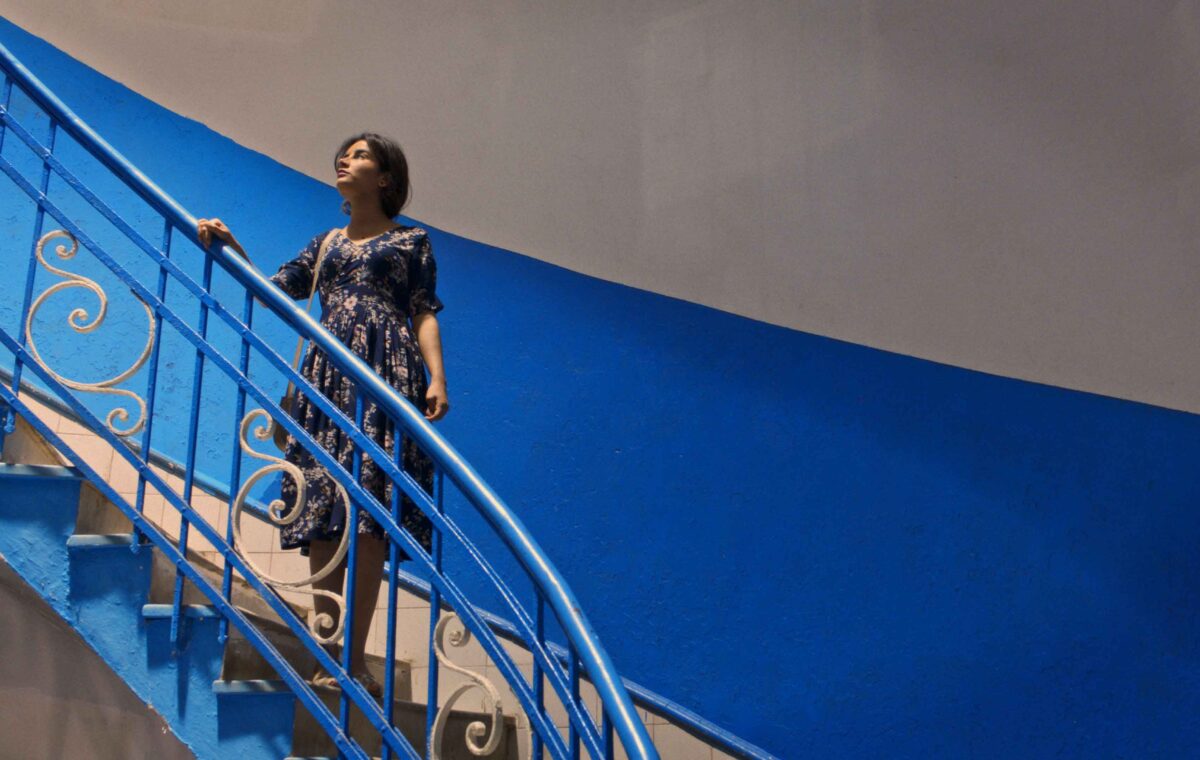
Journal intime follows the relationship of two lovers in Larache, Morocco in an unspecific period. The film explores upon the hurdles that stand in their way in a society that is conservative and unforgiving of non-marital relationships. Directed by Mohamed ChrifTribak, the film was captured by Tribak’s frequent collaborator, Crînguta Pînzaru SBC.
Pînzaru and Tribak first met at film school at La Fémis in Paris around 26 years ago. “We made a short film together in 2004 and we’ve kept in touch over the years,” begins Pînzaru. “Since then, we’ve done almost every project together. Mohamed first came to me with the idea for Journal Intime and it’s the final part of a trilogy of films we’ve shot together, beginning in 2009.”
The first film in the trilogy is Le temps des camarades (2009), which is about the raising of the Islamic parties in universities in the north of Morocco. The second feature, Petits bonheurs (2016) surrounds the years before the independence in the north of Morocco in and the emancipation of women in a society that is very patriarchal. It was a very delicate subject and it was the continuity from the first feature. It follows Noufissa, a fifteen-year-old girl and her mother who are forced to accept an invitation from a distant cousin to come live with her large traditional family after the death of her father.
Journal intime is about missing intimacy in a patriarchal society dominated by men. “It’s set in a society where the frontier between men and women is almost unbreakable,” adds Pînzaru. “It’s a behind the scenes look at all those missed rendezvous of two lovers in the north of Morocco. We didn’t want to focus on a specific period of time for this. The first film was shot in 35mm in 2007. It was my first and last film shot on 35mm. The second one we shot in 2014, so we shot it in digital with ARRI Alexa XT and the last one was Alexa Mini.”

During prep, Pînzaru watched Jillali Ferhati’s The Beach of Lost Children as a reference for the aesthetic of the beginning of the 80s and for the mood of the female protagonist. The main inspiration, however, came from the works of Moroccan figurative painter, Rachid Sebti. “He’s one of the few Moroccan figurative painters, as figurative painting is forbidden by Islam,” explains Pînzaru. “You find a lot of abstract and very interesting colours, but not figurative painting. So, it was the main inspiration in terms of themes of loss and melancholy in female characters, as well as the colour. It was a feeling I’ve searched for in all three films.”
The colour blue is very present throughout the film. Pînzaru set out to interpret the colours in Islamic culture. “The colour blue doesn’t signify hope like in occidental culture,” she explains. “In Islamic culture, blue is more representative of danger. It’s a colour that’s barely mentioned in Arabic literature because the devil is blue. It’s the equivalent of the colour red in Western culture. It was important for Mohamed to have a very light blue at the beginning of film and to build towards something more threatening and electric and for the colour blue to become more present towards the end. It’s a colour of uncertainty and anguish and we wanted that to be apparent.”
“The colour blue sends information about the dangers and the precarity of the situation for Anissa Lanaya’s character,” continues Pînzaru. “The Moroccan public understood this, but this wasn’t as obvious for Western audiences due to their own interpretation of the colour blue within their own culture. It was important for me to reflect the culture of the place in which the film is set, however. I’m Romanian myself and so I understand other cultural codes that might be different elsewhere.”
When it came to the lighting approach, Tribak didn’t want to focus on realism, but instead on the importance of memories. “The lighting isn’t realistic in that sense and it’s more stylised and I tried to avoid soft lights,” says Pînzaru. “The natural light and contrast in Morocco is very powerful, so he wanted something rough that wasn’t so much about light, but something that resonates with our blue element which is in almost every frame of the movie. The blue colour is always present and evolving.”
Pînzaru’s goal was to emulate Aki Kaurismäki’s style, an overall style that although isn’t very realistic, is stylised. “Mohamed was okay with this proposal. We have three moments in the film, before the preparation of the meeting, after the meeting and the streets and the final part. The boy is our sole focus in the beginning, then the two characters and then we focus on the young lady at the end. It was important to have characteristics for each separate part.”

Another important element was to portray closed and compact spaces throughout the film, giving the audience a sense of claustrophobia. “We don’t see the sky and the camera is almost always tight to the characters,” explains Pînzaru. “We wanted to be reflective of Morocco’s cultural system where the space for the women and the space for the men is two worlds apart and everything is separated. The two characters are trying to have a rendezvous as two lovers, but everything is complicated by the stigma around that in their society. It was very important for our camera to reflect this. It was difficult for us because we didn’t want to include the skyline and we didn’t want to have anything open. Everything is closed – the walls, the buildings and the local stores for example. It’s almost like a phantomatic city.”
Pînzaru and Tribak underwent numerous location scouts throughout Larache to find locations that would work. “I was looking for places with textures that were not only aesthetically pleasing, but were suitable in terms of colours,” adds Pînzaru. “I worked closely alongside our art director to find places that felt less contemporary. Moroccan films don’t have loads of budget, so it was about finding the right locations from the beginning and trying to find a way to frame with what we had found. It works because we don’t feel it’s a modern city and it’s timeless. The apartment is like a character in itself and so it was very important to find a good one; a little bit creepy and abandoned. We finally found the perfect location on our third scout.”
The film was shot across four to five weeks with a modest sized crew. “It was difficult for the actors as we shot in one shot, long single takes, so it was a lot to choreograph. We had one and a half weeks for rehearsals and I had my little camera for still photography and I did a few shots to see the choreography of the actors in the space. It was important for me to find the frame in the set. We only rehearsed the rendezvous scene as it was the most complicated to shoot. It’s a continuity of time, space and emotion and a little bit of everything.”

Pînzaru enjoys the liberty that Tribak gives her when working on projects together. “He’s very open to ideas and everybody and anybody can bring proposals to him,” she says. “I also enjoyed working with colours, as this is the first film I’ve shot where the signification of colours is so integral to the film. It’s a real evolving meaning throughout. It was also a pleasure to work with Anissa Lanaya because I shot her very first film and to see her almost ten years later and to see her more confident about her craft was very precious. She’s very good with the camera. Long shots like this aren’t easy for an actor. I wanted to give her the confidence to forget the camera is there and to focus on her performance. She was very much in confidence with me. It was very hard for her to build this character and relationships with the other characters and the film is on her shoulders.”
Pînzaru and Tribak are already planning another project together, which will serve as the final instalment in the series. “I hope to shoot it next year. It’s the last part of the three movies we’ve made together. It’s something that is so rare and precious. We grew up together, we’ve made short films and our first movies together and taken risks together. When you are working with a director you don’t know it’s different, but here I can try new things. From the beginning, I brought the idea forward about the blue colours with the same signification this colour has in Arab countries compared to western culture and he was a little bit reticent, but after I showed him some pictures and tested some things during prep, he let me try it. So, it’s precious to have somebody who trusts you. It’s instinctive working with him and the most important question for us, is how will Isucceed to translate in images, the feelings that the script wants to bring to theaudience,” concludes Pînzaru.
Additional Crew
Mohamed El Harrak – Set decorator
Jimmy Wolf Nguyen – Colourist
By Oliver Webb