Stijn Van Der Veken – run and gun – on Rogue heroes
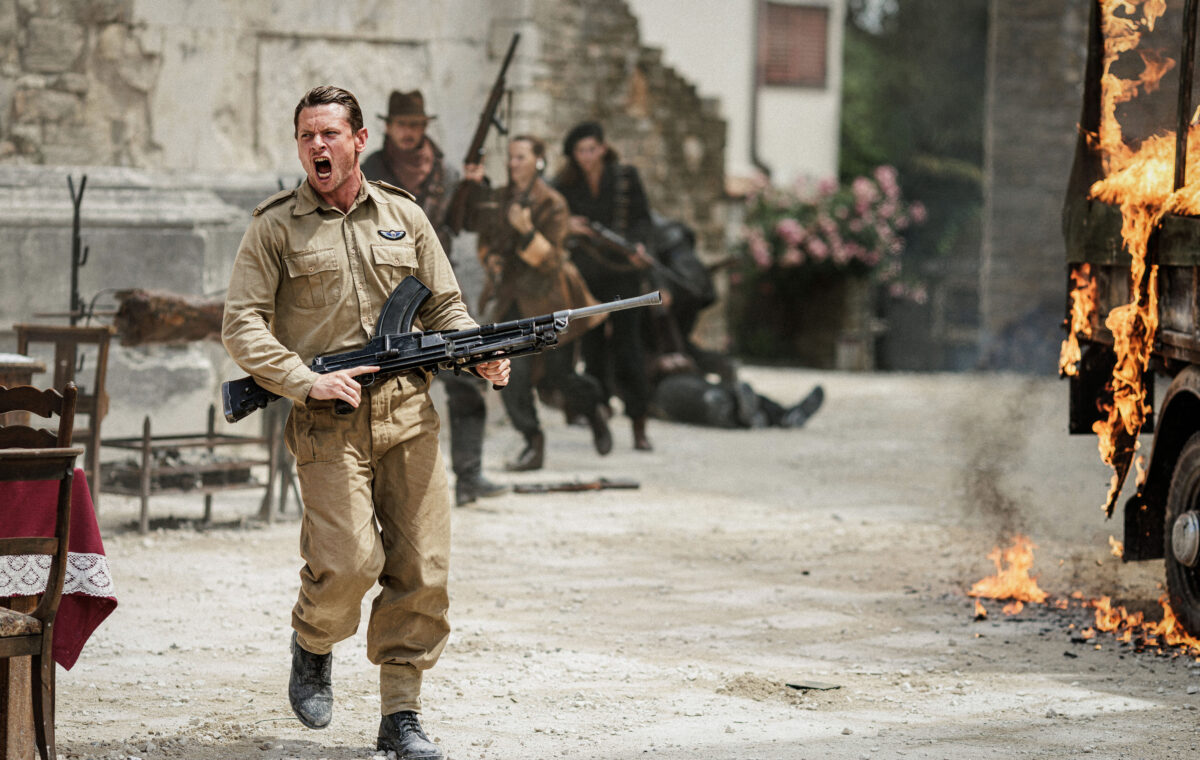
The first season of SAS Rogue Heroes(2022) – created by screenwriter/ producer Steven Knight, directed by Tom Shankland, and shot by DP Stephan Pehrsson – depicting the origins of the British Army Special Air Service (SAS) during the Western Desert Campaign of WWII, proved a five-star runaway success.
The series made its premiere on BBC One on 30th October 2022 in the UK, with the first episode being watched 5,526,000 times on BBC iPlayer alone, making it the fifth most viewed individual programme on the platform that year. So when the show was renewed for a second season, focussing this time on SAS operations in the European theatre of war, with Stephen Woolfenden at helm of the six-part series, its new cinematographer, DP Stijn Van Der Veken SBC ASC, had to rise to the challenge.

“I was thrilled when Stephen asked me shoot SAS Rogue Heroes S2 with him,” says Van Der Veken, who had previously been Woolfenden’s cinematographic collaborator on several episodes of Amazon Prime’sOutlander (2018-2020) and Disney+’s Willow (2022). “Early-on, there were some talks of the show beingsplit between two directors and maybe two DPs, but the producers liked Stephen so much that they asked him to direct them all, and consequently has asked me To shoot them all with him. We were happy with that outcome, because we know each other well and had the opportunity to put our shape and stamp on the full series.”
Whereas production on the first season had largely taken place in Morocco, filming for the second series occurred at locations in Croatia, Italy, England and Scotland over a six-month period between May and September 2023. Studio-based work included the exterior tank at Warner Bros. Studios Leavesden (WBSL) where the night-time, waterborne scenes of the SAS vessels approaching the coast of Sicily were shot. Two separate disused quarries in Hertfordshire were used to capture the ascent of the cliff and firefight on top of the Capo Murro Di Porco.
According to Van Der Veken, production for the six-episode second series consisted of 81 shoot days – justover 13 days per episode – with around 370 scenes,and the best part of 2,000 slates in total, across two filming units. “Obviously, everyone would prefer more time, but I knew the mandated schedule in advance, and that we would have to be quick between set-ups,” he remarks. “We wanted to keep a certain continuity with the first series, in terms of the overall look-and-feel, so we shot in the same widescreen 2.39:1 format, but I knew this series would have a lot more night work with firelight and explosions. “So rather than stay with the original combination of Sony Venice with Kowa Anamorphics, plus K35s forthe VFX work, I went with the ARRI Alexa 35 and HawkClass X lenses as my Anamorphics, with Leitz Hugo primes as my sphericals for some of the heavy VFX sequences and drone shots.”
Expanding on his technical choices, the DP says, “The Alexa 35 was new at the time, and whilst Iappreciate the Sony Venice, the Alexa 35 has more latitude in the highlights and improved colour science.That means you can shoot at night wide-open and still keep orange flames and explosions looking good in your exposure. “The Hawk Class X Anamorphics have a fall-off and bending at the edges that is kinder on faces. As they are a modern design, they have good close-focus and contrast, and are more consistent throughout the different focal lengths from wide to long.”
The camera was provided by KLT Rental in Munich, with lenses supplied by Vantage Film’s Weiden branch for the Croatian and Italian legs ofproduction. Movietech (now Sunbelt Rentals) provided the camera and lens package when the production switched to the UK.
Prior to production, Van Der Veken says he watched the first season of the show multiple times, and even had a call from Pehrsson wishing him good luck. He also studied historical references about the SAS, including a large B&W library of archive materials, assembled by production designer Paul Cripps, which he admits, “gave me a great idea as to the levels ‘rock and roll’ those guys got up to.” Shotdeck also proved a further resource for ideas about contrast, colour and silhouettes to support storytelling beats.
Whilst Van Der Veken prefers to use his own LUTs, the brand new, wider-gamut, LogC4 colour-space of the Alev4 sensor in the Alexa 35 meant having to rebuild from scratch, which he did with Ross Baker, head of colour grading at Molinare in London, who also completed the final DI on the series. “In the end I developed just one LUT for the show using the new colour science in the Alexa 35, which has smooth roll-off on the shoulder and toe of the curve, and is not too contrasty,” he explains. “During production I did some on-set colour tweaks with my DIT, using LiveGrade, and between him and my dailies colourist Mark Glenister back in London, I had the re-timed rushes back on a calibrated iPad Pro a few hours later. Being able to review the footage so speedily was very helpful in keeping-up with the required pace of the schedule, and certainly later-on when we did the final DI.”

SAS Rogue Heroes S2 involved three cameras throughout, two on main unit and one with the second unit, helmed separately by director Adrian McDowall and Rob McGregor working as the DP, who typically filmed time-consuming car and stunt work that wasn’t immediately related to the main cast. “The second unit generally shot on their own, but when we had super-complicated days with a lot of action, they joined us on-set. Stephen likes a lot of coverage, which I think really pays-off in the final show, and shooting with two and sometimes three cameras helped us make the daily page-count.”
With so much action to complete, Van Der Veken eschewed the temptation to operate himself and designated the task to Christopher Reynolds,Bob Shimpsey, Leandro Silva and Paddy Blake which them variously operating handheld and with Steadicams, sometimes supplemented by Rob McGregor when necessary. Chris Rusby was the key grip, with Filip Beatovic the gaffer on the European leg of the production, and John Clarke when production moved to the UK. “I always think the choices you make in terms of framing and moving the camera should be driven by what you have relay to the audience,” Van Der Veken says. “We didn’t want the camera to be a character in the visual storytelling. So we used handheld, Steadicam and Technocranes in an appropriately classical style.”
Van Der Veken says the same philosophy governed his approach to the lighting. “Generally, it was about making each setting believable to the audience. On the day-exteriors, we tried to schedule things to optimism the natural sunlight. However, because of the good weather when we shot, it was not possible to do every take in the perfect direction. So sometimes that meant having to control the light with 20×20 butterflies, and bounce a little fill light back on to the actors. “A lot of the night scenes were lit using real flames from candles and fires, rather than LED flicker systems, which I would soften with diffusion frames if I felt the look was too erratic or contrasty.” There were some scenes, however, that needed a little extra bite, such as the close-up in episode four, set in a dark underground cell where the character is suffering from PTSD. “We lit that scene in order, with a match first, then a cigarette and then a candle,” The DP relates. “The way the light changed between those sources and shaped on his face was fantastic, and the Alexa 35 camera handled that really well at higher ISOs.”

Van Der Veken relished the challenge of shooting big action sequences, especially the waterborne landing and ensuing battle in the first episode. The approach scenes were shot against bluescreen in the tank at Warner Bros. Studios Leavesden, after which the coastal backgrounds were added and extended in post-production, under the supervision of VFX supervisor Dave Sewell. The beach landing and subsequent fight scenes were then shot in two different quarries at separate dates over the course of twelve nights. “Both of the locations, the cliff face and the cliff tops, were big sets, where the camera had to be able to move in 360-degrees. We brought-in two huge mobile cranes that had 70-meter main booms, and fitted them with two banks of tommy bars – big frames with long LED battens in parallel with gaps in-between, that work like softboxes. “I was a bit skeptical of the tommy bars at first, but when we suspended them above the set, the effect was good. Depending on the direction of the shots we were doing, I was able to quickly manoeuvre the cranes, change the height of the booms, the angles of the lights and the lighting intensity as required. I had never worked like that before, and was pleasantly surprised by how efficient it was and the final results.”
Van Der Veken concludes, “I love working withStephen Woolfenden, because he’s well-prepared and greedy, in a good way for a good outcome. This project was hard work and we were all completely exhausted at the end of it all. But a couple of weeks after you have unwound, you start romanticising about the great experience you had. I’m not alone in that, because I received many calls from my crew, asking, ‘If you go again, can we be with we be part of it too?’.”
By Ron Prince for the JANUARY/FEBRUARY 2025 CINEMATOGRAPHY WORLD issue.
https://www.cinematography.world
Images: courtesy of BBC and Banijay Rights/Robert Viglasky